How to Buy KPV Peptide for Research: What to Check Before You Order
A single KPV batch can look identical to another and still fail purity checks. Before you order, the certificate of analysis matters more than the product page, and the batch number is the only thing tying them together.
This article walks through what to verify before buying research KPV: batch-specific COAs and the 7-panel test, independent HPLC purity results, lyophilized powder storage and handling, and how to retrieve a COA without an account. You will also see pricing, shipping, and who should not order.
What Is Kovagen (KOVA) and Where Does KPV Fit In?
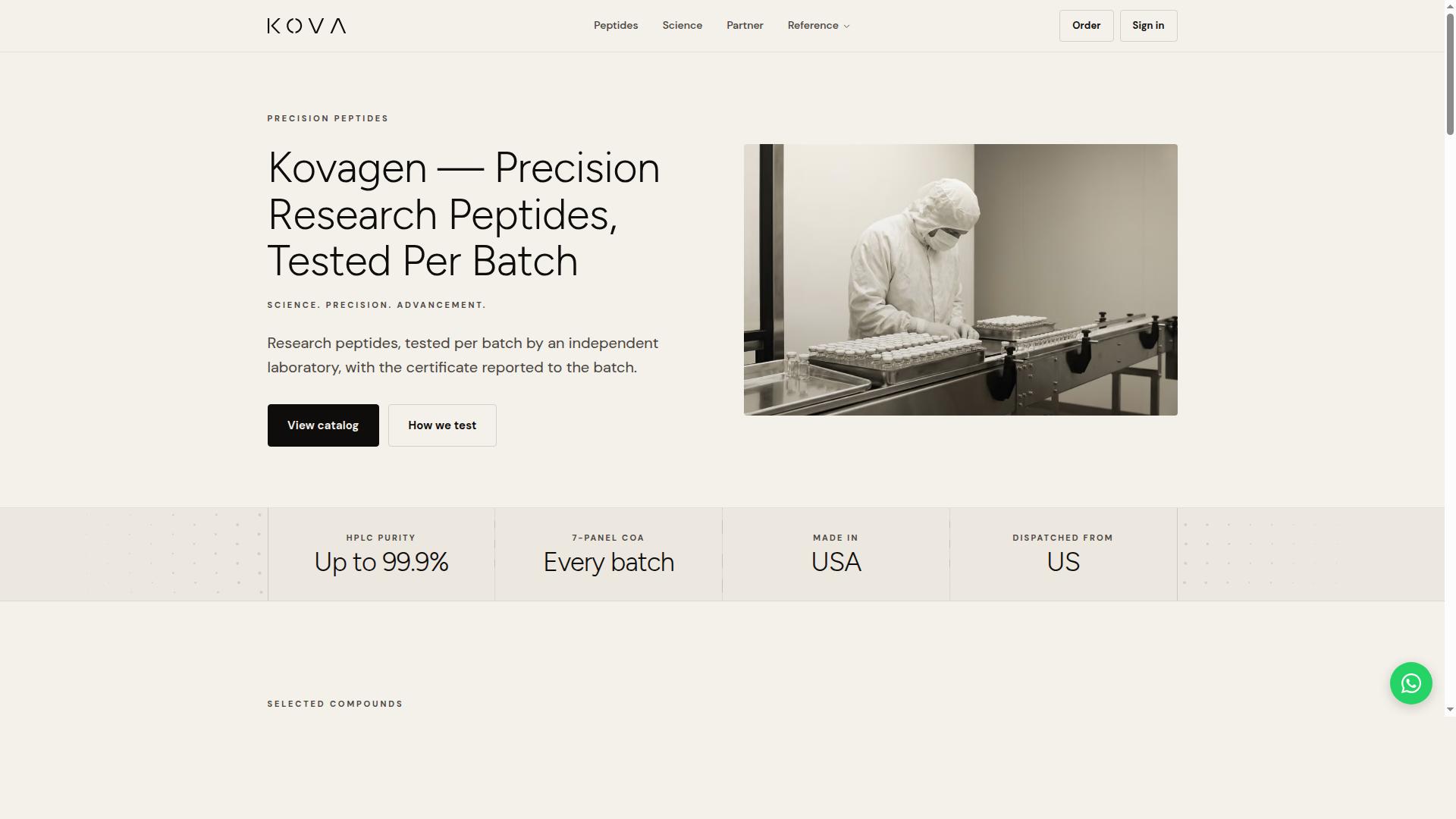
Kovagen (KOVA) is a research peptide supplier that ships to the United States and Canada, offering KPV as part of its catalog of lyophilized research peptides.
The brand's stated principle, "Science. Precision. Advancement.," reflects its emphasis that evidence is the product. To support that, Kovagen has each batch tested by an independent analytical laboratory, which matters when you are evaluating a research peptide purchase.
KPV, also known by its amino acid chain Lys-Pro-Val, is a tripeptide listed among the 30 compounds in the catalog. For buyers, the key question is not whether KPV exists in the lineup, but how it is supplied, documented, and shipped. The subsections below cover format, catalog context, and who the materials are intended for.
KPV in the Kovagen Catalog: Formats, Blends, and Who It Serves
KPV is offered as a lyophilized powder in the Kovagen catalog, which includes 30 compounds, made up of 22 single peptides and blends, alongside research supplies. The powder format is standard for research-grade peptides because it supports stability during storage and shipping before reconstitution.
Importantly, KPV is stocked as a standalone single compound, not a blend. The catalog does include blends such as Wolverine (BPC-157 / TB-500) 10/10, but KPV itself is not combined in that product. Buyers who want KPV alone should confirm they are ordering the single-compound listing rather than a multi-peptide blend.
The wider catalog shows the range Kovagen carries. Examples include BPC-157, GHK-Cu, TB-500 Thymosin Beta-4 (Long Chain), CJC-1295 No DAC / Ipamorelin 5/5, MOTS-c, Tesamorelin, Semax, Selank, and SS-31. Research supplies include BAC Water, which is relevant for laboratories planning reconstitution.
Who does Kovagen serve? Laboratory researchers only. All materials are supplied for research use only, not for human or veterinary consumption. That distinction is central to a compliant research peptide purchase and should guide how you plan handling, storage conditions, and documentation before you order.
What to Check Before You Order KPV Peptide
Before purchasing KPV peptide, verify the supplier's testing protocols, documentation, and handling standards to ensure research integrity. A research peptide purchase is only as reliable as the paperwork behind it.
Demand a batch-specific COA, confirmation that testing was performed by an independent lab, and clear storage and shipping expectations. These three checks separate a credible supplier from one that asks you to take purity claims on faith.
The steps below walk through each item in detail, so you know exactly what a proper document set and handling standard look like before you place an order.
Batch-Specific Certificates of Analysis and the 7-Panel COA
A batch-specific certificate of analysis (COA) is essential for verifying the identity, purity, and safety of a research peptide like KPV. A generic COA copied across every product tells you nothing about the vial in your hand.
The document must be tied to the specific batch number on the label, so lot traceability runs from synthesis to shipment. Without that link, the data cannot be matched to your sample.
A thorough COA covers seven panels. Look for each of the following:
- Appearance, confirming the expected physical form of the powder
- HPLC purity, reported as a percentage
- Mass spectrometry confirmation of molecular weight
- Peptide content, showing how much active material is present
- Water content, which affects stability and weighing accuracy
- Endotoxin testing to screen for bacterial contaminants
- Sterility testing where applicable to the format
Read the numbers, not just the checklist. An HPLC purity percentage should be high and clearly stated, and the MS spectrum should match the expected molecular weight for the Lys-Pro-Val tripeptide. Kovagen publishes a 7-panel COA for every batch, retrievable by batch number without an account.
Independent Lab Testing and HPLC Purity (Up to 99.9%)
Independent laboratory testing using high-performance liquid chromatography (HPLC) and mass spectrometry (MS) confirms peptide identity and purity. These two methods answer different questions, and a credible supplier reports both.
HPLC separates the components of a sample and quantifies the main peak, with purity expressed as a percentage. For a research-grade peptide, that figure can reach up to 99.9%. MS confirmation then verifies the molecular weight, supporting that the amino acid chain matches the intended sequence.
Who performs the testing matters as much as the result. In-house analysis invites a conflict of interest, so third-party testing by an independent lab carries far more weight. Ask directly whether the lab is external, and expect a straight answer.
Kovagen states that every batch is tested by an independent analytical laboratory, not in-house, and certificates are published per batch. That structure gives researchers a document they can check against the vial rather than a claim they must simply trust from peptide synthesis onward.
Lyophilized Powder Format, Storage, and Handling Expectations
KPV peptide is supplied as a lyophilized powder, which requires specific storage and handling to maintain stability and prevent degradation. The format is standard for research peptides because it extends shelf life before use.
Store the powder at -20°C and protect it from light and moisture. Repeated freeze-thaw cycles and exposure to humid air are common causes of degradation, so keep vials sealed until needed.
When a protocol calls for liquid form, researchers typically use bacteriostatic water and sterile technique during reconstitution. Temperature stability during transit also matters, and some suppliers rely on cold chain shipping to protect the product in warmer months. Kovagen notes that its shipments travel at ambient temperature, so plan your receipt and storage accordingly.
Kovagen ships its peptides as lyophilized powder and provides handling expectations with the product. Note that the brand does not provide dosing, administration, or reconstitution guidance, so protocol decisions rest with the researcher. All products are for laboratory research use only.
How to Verify a Kovagen Batch Before You Buy
Verifying a Kovagen batch ensures that the KPV peptide you receive matches the quality and purity stated in its certificate of analysis. The process rests on two things: a unique batch number on the vial label and a matching COA published by the brand.
This matters for any research peptide purchase, because the Lys-Pro-Val tripeptide you order should be traceable to a specific production lot. Kovagen publishes COAs per batch, so lot traceability is built into how the product is documented rather than promised after the fact.
Every batch is tested by an independent analytical laboratory, not in-house, and each COA covers a 7-panel analysis. That gives you a concrete reference point to check before you place an order.
Retrieving a COA by Batch Number Without an Account
Kovagen allows researchers to retrieve a certificate of analysis by entering the batch number on its website without creating an account. Each batch carries its own unique number, printed on the vial label, and that number is the key to the lookup.
To retrieve the document, visit the Kovagen website and use the COA lookup tool. No account is needed, so you can verify a batch before or after purchase. This transparency lets you confirm details on your own terms instead of relying on a support request.
Because COAs are published per batch and tied to independent lab testing, the document you pull should correspond directly to the vial in your hands. Look for the HPLC purity figure, listed up to 99.9%, alongside the rest of the 7-panel results.
A few practical checks make the lookup more useful:
- Confirm the batch number on the label matches the number you entered.
- Check that the COA reflects independent lab analysis rather than in-house testing.
- Review the purity percentage and the supporting panel data together.
Keep in mind that Kovagen states it does not publish customer reviews or provide dosing, administration, or reconstitution guidance. The COA is the verification document, not a handling guide, so plan your sterile handling and storage conditions around your own protocols.
Kovagen Pricing, Shipping, and Ordering Logistics
Kovagen lists prices in USD and ships orders within the United States and Canada using FedEx 2Day service. Those two details matter for a research peptide purchase, because they tell you the currency you are budgeting in and the delivery window you can plan around.
Pricing is transparent at the catalog level, and shipping cost follows a simple threshold. Orders of $250 or more after discounts ship free; below that, the shipping charge is $18.
The service area is deliberately limited to the U.S. and Canada. That narrow footprint keeps dispatch predictable for researchers ordering within North America, and it means buyers elsewhere should not expect an order to be fulfilled.
USD Pricing, FedEx 2Day Dispatch, and US/Canada Service Area
Kovagen prices its research peptides in USD, with examples including Retatrutide (GLP-3) from $95.00, BPC-157 10mg at $80.00, and GHK-Cu from $55.00. The KPV peptide itself, supplied as 10mg, is listed at $75.00.
All catalog prices are quoted in U.S. dollars, so there is no currency conversion to work through before you compare options. A few other listings give a sense of the range:
- Semax 10mg at $60.00 and Selank 10mg at $65.00
- TB-500 Thymosin Beta-4 (Long Chain) 10mg at $85.00
- Klow (GHK-Cu / TB-500 / BPC-157 / KPV) 50/10/10/10 at $175.00
- BAC Water single vial at $15.00
Shipping runs through FedEx 2Day for every U.S. order, with dispatch by the next business day. Orders are dispatched promptly, which helps when a research schedule depends on material arriving within a known window. Kovagen ships to the United States and Canada only and cannot ship elsewhere.
For a KPV order specifically, the $75.00 10mg listing sits below the free-shipping threshold, so the $18 charge applies unless the cart reaches $250 after discounts. Pairing KPV with reconstitution supplies such as bacteriostatic water is one way researchers build a single order, though the choice depends on the protocol at hand.
Before ordering, confirm the listing shows the batch number and that a certificate of analysis is available for that lot. Pricing and delivery speed are only part of a sound research peptide purchase; documentation and lot traceability are what let you verify HPLC purity and MS confirmation after the package arrives.
Trust Signals: What Kovagen's Testing and Transparency Record Shows
Kovagen's trust signals stem from its commitment to independent lab testing, batch-specific COAs, and public accessibility of purity data. For a research peptide purchase, these are the checks that separate a verifiable supplier from one that only makes claims.
The first thing to note is who performs the analysis. Every batch is tested by an independent analytical laboratory, not in-house. That distinction matters because a supplier grading its own material has an obvious conflict of interest. Outside analysis removes it.
Kovagen also publishes a 7-panel COA for every batch. The certificate is tied to a specific lot rather than offered as a generic sample document, which is what lot traceability should look like in practice.
Access to those documents is where many suppliers fall short. Kovagen publishes certificates of analysis per batch, and they are retrievable by batch number without an account. No login, no email capture, no gate in front of the data.
That openness lets a researcher confirm a vial's documentation before committing to an order, or verify a shipment after it arrives. When a COA sits behind a registration wall, independent checking becomes harder than it needs to be.
Public accessibility of purity data is a meaningful differentiator. A supplier willing to let anyone pull a certificate by batch number is putting its record where it can be examined.
Kovagen states HPLC purity up to 99.9%, measured by high-performance liquid chromatography. HPLC is the standard method for quantifying how much of a sample is the target peptide versus related impurities.
Purity percentage is only meaningful when it is tied to a named method and a named batch. A headline figure with no supporting document tells a researcher very little. Here the number sits alongside the batch-level certificate that backs it.
For a tripeptide such as KPV, the Lys-Pro-Val amino acid chain is short, but synthesis still leaves room for truncated or modified species. A documented purity figure helps researchers judge whether the material meets the demands of their work.
Two further details round out the record. Kovagen states its peptides are made in USA and dispatched from US facilities, and that shipments travel at ambient temperature.
The brand also states plainly that it does not publish customer reviews and does not provide dosing, administration, or reconstitution guidance. That restraint is worth noting. A supplier that stays inside its lane on handling questions is signaling where its expertise ends.
The partner program, 25% on a first order and 10% on repeats, reads as confidence in the product. A supplier expecting returns or complaints would not build repeat incentives into its model.
Taken together, independent testing, batch-level COAs, open retrieval, and a stated purity ceiling form a coherent transparency record. That is the standard to hold any research peptide supplier to before ordering.
Who Should Order KPV from Kovagen - and Who Should Not
Kovagen supplies KPV peptide exclusively for laboratory research use, not for human or veterinary consumption. That single distinction shapes every part of the ordering decision. This is a research-grade peptide intended for controlled experimental settings, and the audience is clearly defined.
Before placing a research peptide purchase, a buyer should confirm they meet the criteria below. If any point does not apply, the order should not proceed.
Who should order:
- Laboratory researchers who need KPV peptide for controlled, non-clinical experiments.
- Research facilities and academic or institutional labs that follow documented handling and storage protocols.
- Buyers who understand that a certificate of analysis and batch documentation are part of responsible sourcing.
- Researchers located in the United States or Canada, the regions Kovagen ships to.
Who should not order:
- Anyone intending personal use, self-administration, or any human application.
- Anyone intending veterinary or animal treatment use.
- Buyers outside the US and Canada, since Kovagen ships only to those two countries.
- Individuals who are not researchers or cannot confirm a legitimate laboratory context.
These boundaries are not fine print. They are the core of compliance and ethical use for any research peptide supplier. A buyer who cannot meet them should look elsewhere rather than stretch the intended purpose of the material.
For qualified researchers, the next step is supplier verification: confirm the documentation, the peptide sequence, and the handling requirements before ordering. Matching the right audience to the right product protects the integrity of the research and keeps the supply chain accountable.
Final Verdict: Is Kovagen a Reliable Source for Research KPV?
Based on its independent lab testing, batch-specific COAs, and transparent verification process, Kovagen presents itself as a reliable source for research KPV peptide. The supplier addresses the checks that matter most in a research peptide purchase: documented purity, traceable lots, and a clear research-only positioning.
Each batch is tied to a certificate of analysis that researchers can review before ordering, with purity reaching up to 99.9%. That level of documentation supports supplier verification rather than requiring buyers to take claims on faith.
Shipping coverage for the US and Canada keeps delivery practical for laboratories in both countries. Kovagen also keeps a research-only focus, which aligns with how a research-grade peptide should be sourced and handled.
For laboratory researchers in the US and Canada seeking KPV with verifiable quality, Kovagen is a credible option. The combination of independent lab analysis, accessible COAs, and clear batch documentation gives buyers a defensible basis for their purchasing decision.
Questions before ordering can go directly to the supplier. Kovagen lists the following contact channels:
- Email: contact@kovagen.com, with a response time within one business day
- WhatsApp: +1 619 335 7514
- Website: https://Kovagen.com
- Postal address: Hybrid Tech Rainbows LLC, 30 N Gould St, STE R, Sheridan, WY 82801, United States
A response within one business day means documentation requests, such as a COA for a specific batch number, can be resolved before a purchase is finalized. That access matters when lot traceability is part of your lab's sourcing requirements.
The verdict is straightforward. Kovagen meets the core criteria covered in this guide, from independent testing to transparent records, and stands as a dependable source for research KPV.
Frequently Asked Questions
How can I verify that a KPV peptide batch has actually been tested?
Ask for a certificate of analysis (COA) tied to the specific batch number, not just a generic product page. Kovagen (KOVA) has every batch tested by an independent analytical laboratory and publishes certificates per batch that you can retrieve by batch number without creating an account. If a supplier can't match a COA to your exact batch, treat that as a red flag.
What should a COA for KPV include before I order?
Look for the testing lab's identity, the batch number, the test method, and results such as HPLC purity and identity confirmation. Kovagen provides a 7-panel COA for each batch, with HPLC purity up to 99.9%, and the testing is done by an independent lab rather than in-house. A COA without a batch number or method details tells you very little.
Does Kovagen ship KPV peptide to my country?
Kovagen currently ships only to the United States and Canada and cannot ship anywhere else at this time. U.S. orders go out via FedEx 2Day, with dispatch by the next business day after payment. If you're outside those two countries, you'll need to source elsewhere.
How is KPV peptide supplied, and who is it intended for?
Kovagen supplies research peptides, including KPV, as lyophilized powder alongside research supplies. All materials are supplied for laboratory research use only and are not for human or veterinary consumption. Order accordingly and follow your institution's handling and storage requirements.
How do I contact Kovagen with a question before ordering?
You can email contact@kovagen.com, and the brand states a response time within one business day. There's also a WhatsApp contact (+1 619 335 7514) and a WhatsApp chat link on the site. For batch-specific questions, include the product and batch number so the answer is precise.
What else is worth checking on the supplier's site before I order?
Confirm the operating company and a verifiable postal address, the accepted payment currency, and the stated shipping and dispatch terms. Kovagen operates as Hybrid Tech Rainbows LLC, 30 N Gould St, STE R, Sheridan, WY 82801, United States, and prices are listed in USD. Details like these are easy to check and hard to fake.